
Quantum Algorithm Developer Resume Example
Quantum Algorithm Developer resume example focused on designing quantum circuits, hybrid quantum classical workflows, and practical algorithm benchmarks using Qiskit, Cirq, and PennyLane for research labs and quantum software teams.
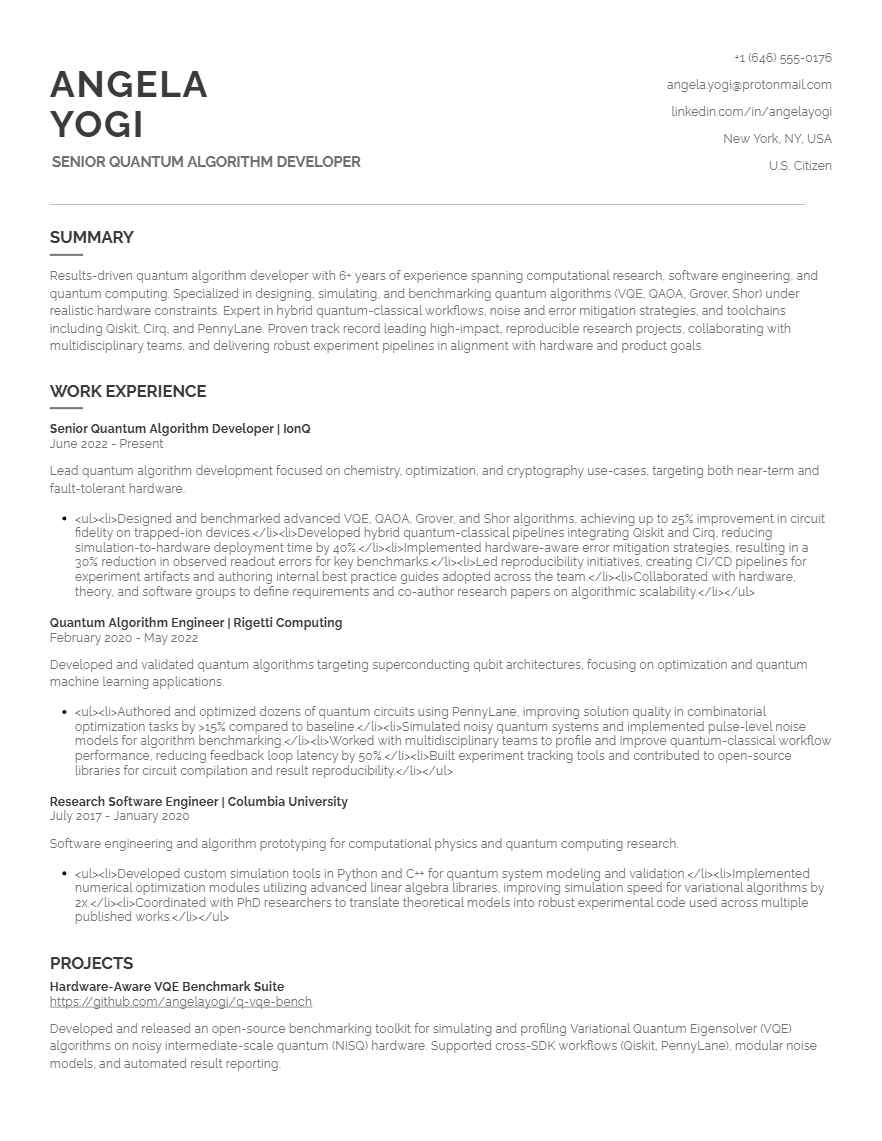
Quantum Algorithm Developer Resume 2026: The Role Where Math Meets Hardware Reality
Quantum computing is not hype when you are the person responsible for turning theory into circuits that survive noise, limited qubits, and real execution budgets.
A Quantum Algorithm Developer resume in 2026 has one job: prove you can take an algorithm from a clean paper idea to something that runs, benchmarks, and teaches the team what is actually possible.
If your resume reads like a glossary of quantum terms, you will lose. If it reads like a record of experiments and outcomes, you will win interviews fast.
What’s ranking when people search “Quantum Algorithm Developer resume”
When you search for resume help in this niche, a few page types show up repeatedly:
- General resume templates that still mention quantum specific titles and tooling, like Teal’s Algorithm Developer resume example page, which even includes “Quantum Computing Algorithm Developer” as a specialization.
- Quantum focused resume templates that list the exact frameworks recruiters expect, like Qiskit and Cirq.
- Practical career advice from quantum community sites that spell out the keyword strategy and portfolio expectations.
- Deep, real world guidance on what hiring teams look for in quantum CVs, like the quantum CV advice post from Musty Thoughts.
That tells you what recruiters are scanning for: credible tooling, concrete algorithm work, and proof you can communicate results.
Before you rewrite anything, run your current draft through the free Resume Scanner to see what keywords and sections you are missing:
Why quantum resumes fail even when the candidate is smart
Quantum candidates often lose to simpler resumes because the resume does not answer basic hiring questions:
- Did you run on simulators only, or on hardware too
- What did you measure, and what improved
- Do you understand noise and constraints, or only ideal math
- Can you write production-grade Python, tests, and reproducible experiments
- Can you explain results to non-physicists on the team
A resume that says “implemented QAOA” is weak. A resume that says “benchmarked QAOA on 3 backends, tracked approximation ratio vs depth, improved convergence by 18% via optimizer and ansatz changes” is strong.
If your structure is messy, start with a clean format first:
The resume structure that works for Quantum Algorithm Developers
Keep it tight and readable:
- 1 page if you are mid-level, 2 pages if you are senior with publications
- Put your best projects in the top half of the page
- Treat “Research and Projects” like a product deliverables section
- Show metrics even if they are research metrics
A hiring team should be able to skim your resume and answer: what you built, what you measured, what improved.
Skills that belong on the resume in 2026
A lot of job posts expect the same toolkit and fundamentals.
Frameworks and languages:
- Qiskit, Cirq, PennyLane
- Python, plus C++ or Rust for performance-sensitive work
Algorithm areas worth naming if you actually did them:
- VQE, QAOA, Grover’s, Shor’s
- Noise awareness, error mitigation, and hardware constraints
Also include the boring but necessary:
- Linear algebra, numerical optimization, profiling, experiment tracking
Do not dump 40 keywords. Group them by responsibility.
Experience bullets that sound credible
Use bullets that show ownership and measurement. Examples:
Quantum Algorithm Engineer
- Benchmarked VQE variants across multiple ansatz choices and optimizers, reducing median energy error by 22% on a noisy simulator and validating trends on hardware runs.
- Built a hybrid workflow that automated circuit generation, transpilation, execution, and analysis, cutting experiment turnaround time from days to hours.
- Added noise-aware evaluation and error mitigation experiments that improved result stability across repeated runs.
Senior Quantum Algorithm Developer
- Led an applied optimization project using QAOA-style approaches, documenting approximation quality vs circuit depth and producing a decision memo for whether to proceed to production experiments.
- Partnered with platform engineers to standardize reproducible experiment artifacts, including pinned dependencies, testable modules, and run logs.
If you want a long-tail reference for how quantum templates present job titles and tags, here is one that matches what recruiters search: quantum algorithm development engineer resume template with Qiskit and Cirq tags
Projects section: the part that wins interviews
Quantum hiring teams care about proof. Projects are proof.
Good project formats:
- 1 line problem statement
- 1 line approach
- 2 to 4 bullets of what you measured and what improved
- Link to code or write-up if you can
If you want to rehearse how to explain your project clearly, use:
And if you want examples of how strong resumes structure projects and impact:
Final checklist before you apply
- Scan for missing keywords and weak phrasing: https://resumefromspace.com/resume-scanner
- Make layout boring and readable: https://resumefromspace.com/selectdesign
- Prepare to explain your best project in 60 seconds: https://resumefromspace.com/interview-trainer
Quantum algorithm work is hard. Your resume should make it look clear, measurable, and real.
Land your dream job with Tailored AI-Powered Resume
Our AI-powered resume builder creates perfect resumes in minutes, giving you the edge in today's competitive job market.